A few years ago, during an intermediate Korean class, one of my students—let’s call him Alex—came up to me after a quiz holding his paper with a huge grin. “Teacher,” he said proudly, “이 시험은 식은 죽 먹기였어요!” (This test was eating cold porridge!)
He got the idiom completely right, but we both ended up laughing because the literal image in his head was so vivid. In English, when something is ridiculously easy, you’d probably say it’s “a piece of cake” or “a breeze.” In Korean, we compare effortless tasks to eating a bowl of cooled-down rice porridge: 식은 죽 먹기 (sigeun juk meokgi).
After teaching Korean to hundreds of English speakers over the past decade, I’ve noticed that mastering idioms is usually the exact moment my students bridge the gap between sounding like a textbook and sounding like a real human. So today, let’s talk about why Koreans use cold porridge as a metaphor for easy tasks, how to use it in real life without sounding awkward, and how it compares to another phrase you’ve probably heard in K-dramas.
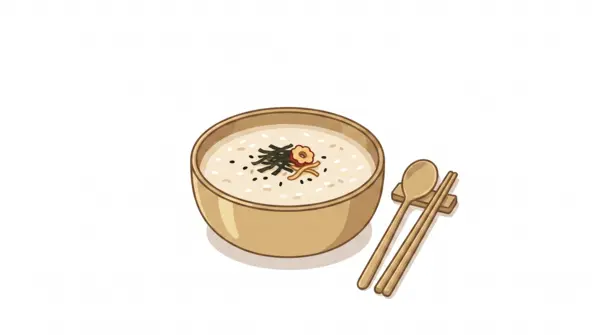
Why “Cold” Porridge? The Story Behind the Phrase
If you’ve ever had traditional Korean juk (죽)—our version of savory rice porridge—you know it comes out of the kitchen piping hot. You have to gently blow on every single spoonful and take tiny, careful bites so you don’t burn the roof of your mouth. Honestly, eating hot porridge takes patience!
Now, picture that exact same porridge, but it has cooled down completely (식은 죽).
- You don’t have to wait around for it to cool off.
- It’s soft and broken down, so you don’t even need to chew it.
- You can literally scoop it up and swallow it in seconds with zero effort.
That’s the picture behind 식은 죽 먹기 (eating cold porridge / a piece of cake). Ancient Koreans used this everyday visual to describe any task, assignment, or challenge that requires practically zero energy and carries zero risk of failure.
How Native Speakers Actually Use It in Daily Life
In textbooks, you often see full, formal sentences that sound a little stiff. But on the streets of Seoul—or when texting your Korean friends—we rarely speak in formal dictionary forms.
Most of the time, we attach -야 (-ya) in casual speech or -예요 (-yeyo) in polite speech: “에이, 식은 죽 먹기지!” (Come on, it’s a piece of cake!).
Here are two quick scenarios to show you how it flows in real conversations:
Scenario 1: Talking about an easy test or project
- Friend: “이번 과제 제출하는 거 어렵지 않았어?”(Wasn’t it hard submitting this assignment?)
- You: “아니, 어제 다 해놔서 나한테는 식은 죽 먹기였어.”(Nah, I finished it yesterday, so for me it was a total piece of cake.)
Scenario 2: Reassuring someone you can help
- Coworker: “혹시 엑셀 피벗 테이블 만드는 법 알아? 너무 어렵다…”(Do you happen to know how to make Excel pivot tables? It’s so tricky…)
- You: “그럼요! 이 정도는 식은 죽 먹기예요. 제가 금방 해드릴게요.”(Of course! Something like this is as easy as pie. I’ll do it for you in a jiffy.)
“식은 죽 먹기” vs. “누워서 떡 먹기” (The Classic Mix-Up)
Whenever I teach this unit, my students almost always ask: “Wait, Anna! What about 누워서 떡 먹기? Isn’t that the exact same thing?”
You’re totally right—both are translated as “a piece of cake” in English dictionaries. But if you want to sound like a true insider, there’s a funny subtle nuance between the two that most textbooks skip.
- 식은 죽 먹기 (Eating Cold Porridge): 100% safe, smooth, and effortless. Eating soft, cooled porridge carries zero physical risk. This is ideal for exams, mental tasks, software work, or routine daily chores.
- 누워서 떡 먹기 (Eating Rice Cake Lying Down): Think about this one realistically for a second. If you lie flat on your back and try to eat chewy Korean rice cake (tteok), you could actually choke!
Historically, “eating rice cake while lying down” meant a task was so simple you could do it while relaxing in bed. But native speakers secretly know it’s a slightly ridiculous visual. While both are used today, 식은 죽 먹기 is by far the smoother, most natural, and universally used expression in both formal and informal settings.
Anna’s Pro-Tip & Final Thoughts
Idioms are my absolute favorite thing to teach because they offer a real window into Korean culture and humor. You don’t need to stress yourself out trying to memorize fifty expressions at once—just start with this one!
Next time a friend or your Korean tutor asks if a task is difficult, give them a confident smile and say:
“에이, 이 정도는 식은 죽 먹기죠!” (Pfft, this is a piece of cake!)
What is one skill, hobby, or task in your life that feels like 식은 죽 먹기 for you? Let me know in the comments below—I read every single one and love chatting with you guys!
And if this lesson helped, don’t forget to bookmark allaboutkorea101.com for more practical, real-world Korean language tips.