Have you ever overheard a Korean coworker whisper, “I feel like a shrimp with a broken back right now,” in the middle of a tense boardroom meeting and wondered what ocean documentary they were talking about?
That is the absolute beauty of diving into Korean Idioms. Real language learning isn’t about memorizing stiff, textbook vocabulary; it’s about unlocking those hilarious, dramatic metaphors that native speakers use to describe the messy realities of life. And among all the expressive sayings in Korea, few capture life’s unfair moments as brilliantly as “고래 싸움에 새우 등 터진다” (Gorae ssaum-e saewu deung teojinda).
If you’ve ever been the innocent party crushed between two arguing giants—whether it’s two battling bosses at work, arguing parents, or a pair of dramatic friends—this phrase was practically crafted for your pain. Let’s unpack this iconic expression, explore its rich cultural roots, and see how you can drop it into everyday conversation like a seasoned native speaker!
Breaking Down the Vocabulary in Korean Idioms
Whenever I introduce new Korean Idioms in my classroom, I always like to break down the individual words first. It makes the expression so much easier to remember! Here is how this phrase is built:
- 고래 (Gorae): Whale (The giant king of the ocean)
- 싸움 (Ssaum): Fight, battle, or conflict
- 에 (-e): In, at, or during (location/time marker)
- 새우 (Saewu): Shrimp (The tiny, fragile sea creature)
- 등 (Deung): Back (referring to its delicate shell)
- 터진다 (Teojinda): Breaks, bursts, or gets crushed
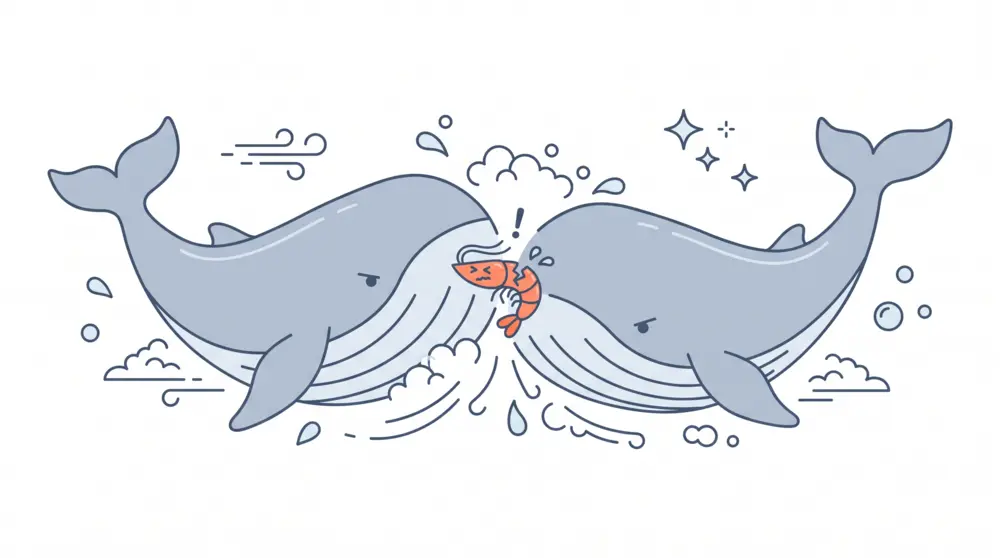
When you string these together, the literal translation is: “In a battle between whales, a shrimp’s back breaks.”
Picture two colossal sea creatures thrashing around violently in the deep sea. They aren’t trying to target the tiny shrimp. In fact, they probably don’t even know it’s there! But because the poor little shrimp happens to be swimming nearby, it gets badly hurt purely from the massive underwater shockwaves. Visualizing this scene helps you instantly grasp the emotional core of the expression.
The Deeper Meaning Behind Popular Korean Idioms
Beyond the funny ocean imagery, what is this saying actually trying to tell us? In short, it describes a situation where a weak or innocent third party suffers harm solely because two powerful figures are fighting.
In Western terminology, we often call this “collateral damage.” But what makes this expression so relatable is the feeling of complete helplessness. The “shrimp” didn’t start the argument, had zero interest in who wins, and had no power to stop the fight—yet ended up taking the brunt of the damage. In my years of teaching, I’ve found that foreign learners love this idiom because almost everyone has been the “shrimp” at least once in their life!
Why Ocean Life Shows Up in Traditional Korean Idioms
My students often ask me, “Anna, why whales and shrimp? Why not lions and mice?” That is a fantastic question! To understand Korean Idioms, you have to look at Korea’s geography and culture.
Korea is a peninsula surrounded by ocean on three sides. For centuries, marine life and coastal experiences naturally shaped everyday speech and folklore. To ancient Koreans, the whale represented an overwhelming, uncontrollable force of nature (or high-ranking officials), while the humble shrimp represented the everyday working folks. By putting the ocean’s biggest mammal next to one of its smallest crustaceans, our ancestors created a memorable lesson about the massive power imbalances in human society.
How to Use Korean Idioms in Everyday Life
You don’t need to be in the middle of an international war to use this phrase. Native speakers use many Korean Idioms like this one in everyday situations—especially when venting about office drama or family conflicts. Here are a couple of classic scenarios:
Scenario 1: Workplace Politics
Imagine two project managers at your company arguing over who gets a bigger department budget. Neither side wants to back down. To make themselves look busy and important, both managers start dumping last-minute research tasks on a newly hired junior team member.
Exhausted at midnight, the junior worker might text a colleague:
“이사님들 기싸움 때문에 내가 죽겠어. 완전 고래 싸움에 새우 등 터지는 중이야.” (I’m dying because of the directors’ power struggle. I’m literally a shrimp caught in a whale fight.)
Scenario 2: Global Trade & Economics
You will also hear news anchors use this phrase when covering global economics. When two economic superpowers get into a tariff war, smaller trade-dependent nations often suffer massive losses through no fault of their own.
English Expressions vs. Korean Idioms
While the ocean metaphor is uniquely Asian, English actually has a few expressions with a similar vibe. Comparing them is a great trick for remembering new vocabulary!
- “Caught in the crossfire” — This is probably the closest everyday match, focusing on being an accidental victim during someone else’s argument.
- “When elephants fight, it is the grass that suffers” — A famous African proverb that uses land animals to express the exact same power dynamic!
- “Collateral damage” — A more formal, military or corporate term for unintended harm.
A Teacher’s Insider Tip for Mastering Korean Idioms
Here is a quick tip from my years in the classroom: Don’t worry about reciting the entire dictionary definition when speaking with native speakers. In casual Korean conversations, people usually drop this phrase as a short, dramatic reaction to a situation.
For instance, if your Korean friend is complaining about getting stuck in the middle of their parents’ or bosses’ argument, you can simply reply:
“완전 고래 싸움에 새우 등 터진 격이네!” (That’s literally a case of a shrimp’s back breaking in a whale fight!)
Dropping a well-timed idiom like this shows that you don’t just know words from a textbook—you truly understand the subtle humor and heart of the Korean culture. Keep practicing, stay curious, and enjoy the journey of mastering Korean Idioms!