Have you ever been typing a text message about a friend, only to have that exact person call you the very second you hit send? It’s a bit eerie, right? In English, you’d probably laugh and say, “Speak of the devil.” But here in Korea, we bring a much bigger, fluffier, and historically terrifying guest to the conversation. We say: “호랑이도 제 말 하면 온다,” which means “Even a Tiger Comes When Spoken Of.”
Look, I’ve been teaching Korean to wonderful students from all over the world for over ten years now, and I see it happen all the time. The exact moment we start learning idioms, my students either light up with pure excitement or look completely overwhelmed, ready to throw their hands up. And honestly? I don’t blame you at all. Staring at a textbook, trying to force-memorize dry dictionary definitions is just exhausting. That’s why I always tell my students to take a deep breath, stop memorizing, and let’s paint a historical picture instead. Today, I want to gently walk you through why this beautiful, powerful tiger suddenly pops up in our everyday casual chats, how its vibe is so different from the Western “devil,” and how you can use it naturally to sound just like a native speaker.
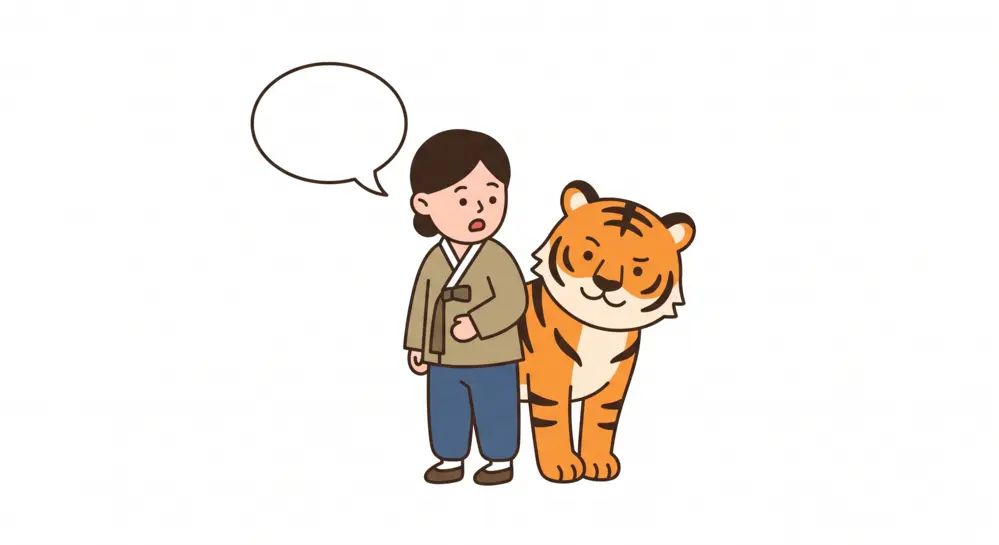
e Kingdom of tigers
If you look at a map of the Korean peninsula, some say the rugged, mountainous terrain looks like a tiger standing on its hind legs. This isn’t a coincidence. Centuries ago, during the Joseon Dynasty, Korea was known throughout Asia as the “Kingdom of Tigers.” These weren’t just animals living peacefully in the woods; they were a constant, terrifying threat to human survival. Wandering between villages meant risking a literal encounter with a giant predator.
Because the fear of tigers was so deeply woven into the cultural psyche, an ancient superstition took root: the belief that words possess a spiritual energy strong enough to manifest reality. People genuinely believed that whispering a predator’s name out loud could summon its spirit right to their doorstep. Therefore, saying “Even a Tiger Comes When Spoken Of” wasn’t just a clever joke back then—it was a survival rule. It was a warning to watch your mouth because your words carried weight. Today, while you won’t find wild tigers roaming the streets of Seoul, the psychological caution about the power of timing and speech remains deeply embedded in the Korean vocabulary.
2. A Teacher’s Breakdown: Making the Grammar Feel Natural
Whenever I introduce this phrase in my intermediate classes, my students usually blink at me blankly because it looks like a massive wall of text. Let’s demystify it together. If we break the idiom down into bite-sized pieces, the linguistic logic actually makes beautiful sense:
- 호랑이 (Ho-rang-i): The star of the show—the tiger.
- 도 (-do): This tiny particle is crucial. It means “also” or “even,” adding that dramatic emphasis (Even a tiger!).
- 제 (Je): A possessive pronoun meaning “one’s own.”
- 말 (Mal): Speech, words, or the act of talking.
- 하면 (Ha-myeon): The conditional “if” or “when” grammar structure (If you speak…).
- 온다 (On-da): The plain, present-tense narrative form of the verb “to come” (오다).
When you string it all together naturally, it rolls off the tongue with a specific rhythm that every native Korean recognizes instantly. Don’t worry about practicing the whole sentence at lightning speed right away; focus on the rhythm of Ho-rang-i-do… and the rest will follow.
3. Why “Even a Tiger Comes When Spoken Of “Has a Warmer Vibe Than the Devil
One of the biggest mistakes I see language learners make is assuming that a translation completely covers the emotional nuance of a phrase. While “Speak of the devil” and “Even a Tiger Comes When Spoken Of” are used in identical situations—when someone appears unexpectedly while being discussed—the underlying “vibe” is entirely different.
In Western culture, invoking “the devil” usually carries a slightly mischievous, cynical, or negative undertone. It often implies you were caught gossiping or saying something a bit naughty behind someone’s back. In contrast, the Korean tiger carries an aura of power, respect, and awe. Because of this, our tiger idiom is incredibly versatile. Yes, you can use it when you get caught playfully gossiping, but we use it just as often in incredibly positive, warm contexts. For example, if I am telling a colleague how much I appreciate a student’s hard work, and that exact student walks into my office with a hot latte, saying this phrase is a compliment. It highlights the fascinating, magical timing of their arrival and acknowledges their strong, positive presence.
4. Real Classroom Stories: Seeing the Tiger in Action
To show you exactly how this plays out in real life, let me share a funny story from a conversation class I taught last semester. We were talking about weekend plans, and a student named Julian mentioned that our classmate, Maria, was always incredibly late to everything.
- Julian: “I tried calling Maria three times, but she’s probably still asleep. She is going to ruin our group project timeline!”
- Me (Teacher): “Give her a few more minutes, Julian. She might be on her way.”
- (At that exact moment, the classroom door swings open, and Maria walks in, completely out of breath)
- Maria: “I am so sorry I’m late! Traffic was a nightmare!”
- Julian & Me: (Laughing together) “호랑이도 제 말 하면 온다더니! (They say even a tiger comes when spoken of!) We were literally just talking about your phone being off!”
Notice how Julian added ~다더니 to the end of the phrase? In real-life Korean conversations, natives rarely say the textbook version (온다). Instead, they shorten it to “호랑이도 제 말 하면 온다더니!” or simply shrug and say, “어머, 호랑이도 제 말 하면 오네!” Drop that shortened version during your next K-drama discussion or conversation with a Korean friend, and watch their eyes light up with surprise.
What’s Your Cultural “Tiger”?
Learning a language is never just about memorizing words; it’s about stepping into a completely new worldview. The next time a coincidental arrival catches you off guard, skip the devil and call upon the majestic Korean tiger instead.
I’m curious—what do people say in your country when someone unexpectedly pops up during a conversation? Do you have a scary creature or a funny superstition attached to it? Drop a comment down below and let’s chat!