There is a secret love language hidden inside almost every K-drama, and it has absolutely nothing to do with dramatic hand-holding, expensive gifts, or confessions in the rain. Instead, it sounds like a simple, everyday question: “Did you eat?” (밥 먹었어? – Bap meogeosseo?).
When foreign drama fans first notice this, they often ask me with genuine confusion, “Teacher, is everyone in Korea just constantly hungry? Why is this the first thing they ask in a serious scene?”
It’s a hilarious but beautiful cultural misunderstanding. To Western viewers, asking about a meal feels purely functional—like checking off a chore. But in Korea, “Bap meogeosseo?” is one of the deepest, most affectionate expressions of love, care, and empathy you will ever hear. Let’s decode the secret cultural subtext behind this legendary Korean phrase!
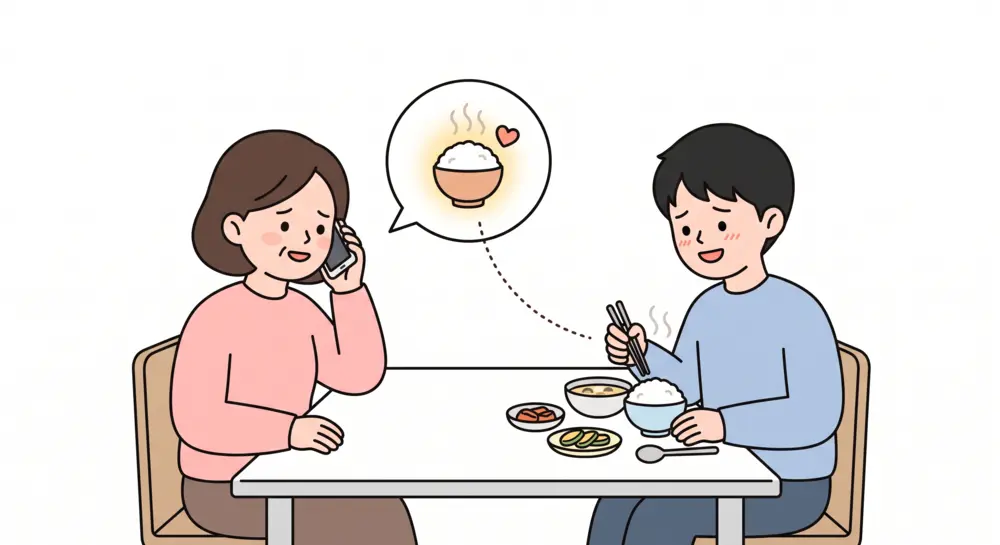
The Literal vs. Cultural Meaning of “Bap Meogeosseo” (밥 먹었어?)
If you translate it literally, “Bap” (밥) means cooked rice or a meal, and “meogeosseo?” (먹었어?) means “did you eat?”.
However, in the Korean language, the cultural translation of this phrase is actually closer to “How are you?” or “I care about your well-being.”
In English-speaking countries, people casually say, “What’s up?” or “How’s it going?” without expecting a detailed report on your life. In Korea, we ask about your meal. If someone asks you this, they aren’t trying to invite you to dinner (usually), nor are they being nosy. They are checking if you are living comfortably and taking care of yourself.
The Historical Roots: Why Food Equals Survival and Love in Korea
To truly appreciate this phrase, we have to look back at Korea’s history. Not too long ago, during the Korean War and the periods of extreme poverty that followed in the mid-20th century, starvation was a real, daily threat. Food was scarce, and secure meals were never guaranteed.
During those harsh times, asking someone, “Did you have breakfast/lunch/dinner?” was the most direct way to ask, “Are you surviving? Are you okay?”
Even though South Korea has transformed into a global economic powerhouse, this linguistic habit has remained deeply rooted in our DNA. To this day, making sure someone is well-fed is the ultimate sign of respect and affection.
Decoding “Bap Meogeosseo” in 3 K-Drama Scenarios
When you watch dramas, the meaning of this question shifts beautifully depending on who is saying it. Here is how to decode the subtext like a native:
1. The Worried Parent or Grandma (Maternal Love)
Whenever a character returns home or calls their mother, the first words out of the parent’s mouth are almost never, “I missed you.” Instead, it’s a high-pitched: “밥은 먹고 다니냐?” (Bap-eun meoggo danya? – “Are you eating well while you’re out there?”).
If the character says they skipped a meal, the mother will immediately ignore all conversation and start busy cooking in the kitchen. In Korean family dynamics, cooking a warm meal is how parents say, “I am proud of you, I love you, and I am here for you.”
2. The Romantic Hero’s Subtle Flirting (Hidden Affection)
This is what confused my intermediate student! In romantic K-dramas, a love interest will often text or call to ask, “Bap meogeosseo?”
Here is the secret translation: “I was thinking about you, I want to make sure you’re taking care of yourself, and honestly, I am looking for an excuse to talk to you.”
It’s a low-pressure, incredibly sweet way to show affection without being overly aggressive. It shows they care about your basic daily comfort.
3. The Coping Mechanism in Sad/Angry Moments (Empathy)
Have you ever seen a scene where a character is crying, and their friend sits next to them, hands them a spoon, and gently says, “Let’s eat first”?
In Korean culture, hunger makes sadness worse. Even in the face of tragedy (like a funeral or a breakup), the common wisdom is to eat so you have the physical strength to endure the pain. Asking “Did you eat?” in a sad situation translates to: “I know you are hurting, but please stay strong. I am here to help you carry this weight.”
How to Respond to “Bap Meogeosseo?” Like a Native
If a Korean friend or colleague asks you this, how should you reply? Follow this simple rule of thumb:
- If you DID eat: Say, “응, 먹었어! 너는?” (Eung, meogeosseo! Neoneun? – “Yeah, I ate! How about you?”).
- If you DID NOT eat (and want to hang out): Say, “아직 안 먹었어. 같이 먹을래?” (Ajik an meogeosseo. Gachi meogeullae? – “Not yet. Do you want to eat together?”). This is the perfect, natural green light for a lunch date!
Conclusion: Food is the Language of Love
The beauty of the Korean language lies in its deep emotional subtext. “Bap meogeosseo?” is so much more than a question about rice. It is a historical habit of survival that evolved into a modern language of deep empathy, protection, and love.
So, the next time you hear this line in a drama, look past the literal subtitles. You aren’t just watching a character ask about food; you are witnessing a heart-warming display of pure Korean care.