Hey there, fellow K-drama lover!
If you are reading this, chances are you’ve spent way too many late nights smiling at your screen, watching your favorite leads fall in love. But let’s be honest—when you try to look up how to say those sweet things in a standard textbook, you end up with rigid, formal phrases like “How are you?” or “It is a pleasure to meet you.” Nobody actually talks like that when they are flirting!
In fact, one of my current students is a massive K-drama fan, and her Korean sounds incredibly natural. Instead of sounding like a stiff translation app, she uses real, living expressions that native speakers actually say every day. When people ask for her secret to sounding so fluent without memorizing boring grammar drills, she always smiles and gives the same answer: it was all from watching K-dramas.
Real, authentic Korean is found in the scripts of the shows we love, written by creators who know exactly how modern couples speak, text, and tease each other in real life. If you want to take your Korean to the next level and sound like a real person, you are in the right place. Let’s dive into some of the most romantic and cute korean phrases straight from famous K-dramas that you can actually use in real life.
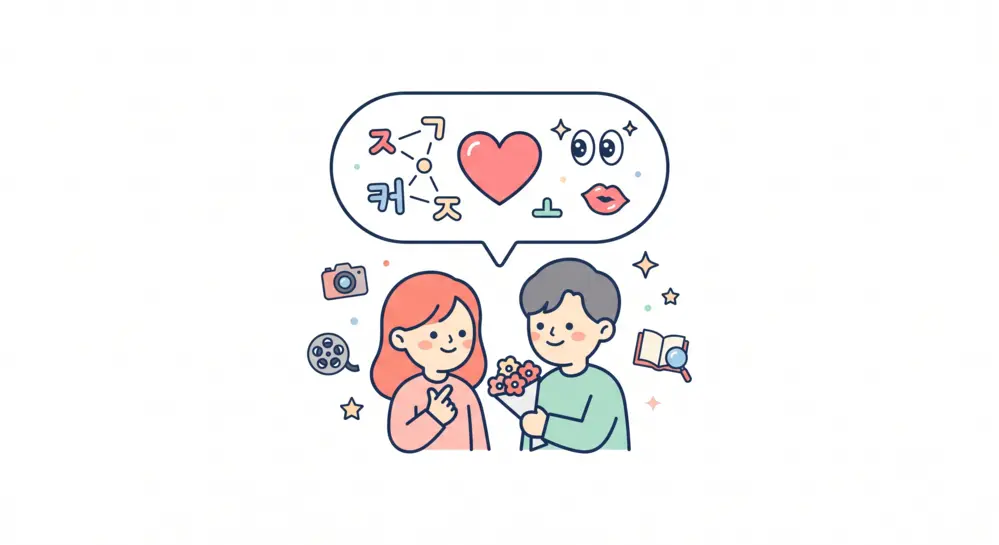
1. Ditching the Textbook: How to say “I Miss You”
In traditional Korean culture, expressing deep feelings was usually pretty indirect. But modern romance—both on-screen and in real life—is all about being open and vulnerable.
The Line from Crash Landing on You (사랑의 불시착)
- The Vibe: “내가 보고 싶었소?” (Did you miss me?)
While Captain Ri’s specific dialect is unique to the show, the core phrase everyone uses is 보고 싶다 (bogo sipda). Textbooks will tell you this means “I miss you,” but literally, it means “I want to see you.” There is a beautiful, physical longing baked right into the words.
If you are talking to someone you are close to, just drop the formal endings and say: “보고 싶어” (bogo sipeo).
Want to make it extra cute? Try adding a soft nasal sound at the end: “보고 싶당” (bogo sipdang). It gives the phrase a playful, whiny twist (what Koreans call Aegyo) that instantly softens the mood and makes it sound incredibly sweet.

2. The Art of the Casual Poke: “By Any Chance…”
The biggest giveaway that someone is using a rigid translator is the lack of casual conversational pieces. Real people use tiny, subtle words to test the waters before making a move.
The Famous K-Drama Line from Weightlifting Fairy Kim Bok-joo
- The Vibe: “혹시 메시 좋아하세요?” (Do you happen to like Messi?)
On the surface, asking someone if they like a soccer player sounds a bit random. But linguistically, the magic is all in that first word: 혹시 (hoksi), which means “by any chance” or “do you happen to.” It softens the question completely, making the speaker look a little shy and totally approachable.
If you want to suggest grabbing food or hanging out without sounding way too intense, start your sentence with hoksi. For example: “혹시 시간 있어?” (Hoksi sigan isseo? / By any chance, do you have time?) with a slight lift at the end of your voice. It creates a comfortable, low-pressure space that still carries a spark of romantic potential.
3. Texting Like a Local: Mastering Subtle Aegyo
A lot of people think Aegyo (cute behavior) is just about doing exaggerated hand gestures like K-pop idols on variety shows. In reality, everyday cuteness is much quieter. It lives inside how people stretch out their vowels or tweak their spelling over text.
The KakaoTalk Twist: Changing ~야 (ya) to ~얌 (yam)
When couples in Korea text each other, they rarely use perfect dictionary spelling. Instead of a basic “뭐 해?” (Mwo hae? / What are you doing?), they will text “뭐행?” or “뭐얌?”.
By adding that quick ‘ㅇ’ or ‘ㅁ’ sound to the end, a mundane check-in instantly becomes a playful, affectionate poke. It is the digital equivalent of a sweet smile, bridging the gap between normal conversation and intimate warmth.
4. Terms of Endearment That Actually Sound Natural
Forget the formal words for husband or wife that you see in vocabulary lists. If you hang out in trendy neighborhoods in Seoul like Hongdae or Seongsu-dong, you’ll hear young couples using completely different names.
- 자기야 (Chagiya): This basically translates to “honey” or “darling.” It’s totally gender-neutral, and couples who are comfortably dating use it all the time. Fun fact: it actually comes from the word for “oneself,” beautifully implying that your partner is a part of you.
- 오빠 (Oppa): Originally just meant for an older brother, but it has evolved into a major romantic term. When said with a soft, slightly drawn-out tone, it carries a unique sense of closeness and affection.
- 내 사랑 (Nae Sarang): Literally “my love.” It sounds a bit dramatic, but couples often toss it into daily conversations playfully to smooth over a tiny argument or just show some sudden affection.
Wrap-Up: Find Your Own Voice
As your Korean teacher, if there is one piece of advice I want you to take away from this, it’s this: mastering romantic or cute Korean isn’t about memorizing lines like you’re auditioning for a drama. It’s about catching the vibe and learning to speak exactly like real Korean people do.
When you challenge yourself to listen to their intonations on screen and practice using those expressions in real life, something magical happens. You aren’t just translating words in your head anymore. By sharing their emotional high and low notes—the laughter, the teasing, the subtle sighs—and embracing the unique culture baked into the language, you will unlock the true, living meaning of Korean.
Don’t be afraid to play around with these phrases! Try using a cute text modifier or a soft interjection with someone you’re close to. Keep watching, keep practicing, and remember—I’m always here cheering you on your journey to true fluency.