
Welcome to All About Korea 101! I’m Anna, a Korean language educator and author, and I’m thrilled to help you take your very first steps into mastering Hangul (the Korean alphabet).
When students begin their Korean learning journey, many rush straight into memorizing complex phrases or flashcard apps. However, having taught Korean to self-learners for over a decade, I can tell you that the true secret to long-term fluency begins with muscle memory. Specifically, dedicated Korean basic vowels writing practice is the single most effective way to internalize how Korean syllables are constructed, balanced, and pronounced.
In the Korean writing system, vowels represent the vibrant core of every single syllable block. Without a solid grasp of how to write and pronounce the six fundamental vowels—ㅏ, ㅓ, ㅗ, ㅜ, ㅡ, ㅣ—reading real-world Korean, following along with K-drama subtitles, or deciphering native handwriting can quickly become overwhelming.
To ensure you start on the right foot, this comprehensive guide will break down the essential stroke order rules, mouth shapes, and common beginner pitfalls. Best of all, you can download our free printable PDF Korean vowels writing practice worksheet to practice handwriting right at home. Let’s dive in!

The Two Golden Rules of Korean Stroke Order
Before you pick up your pen for your Korean vowels writing practice, it is essential to understand why stroke order matters. Korean is not drawn arbitrarily; it follows a scientific, geometric rhythm created during the Joseon Dynasty.
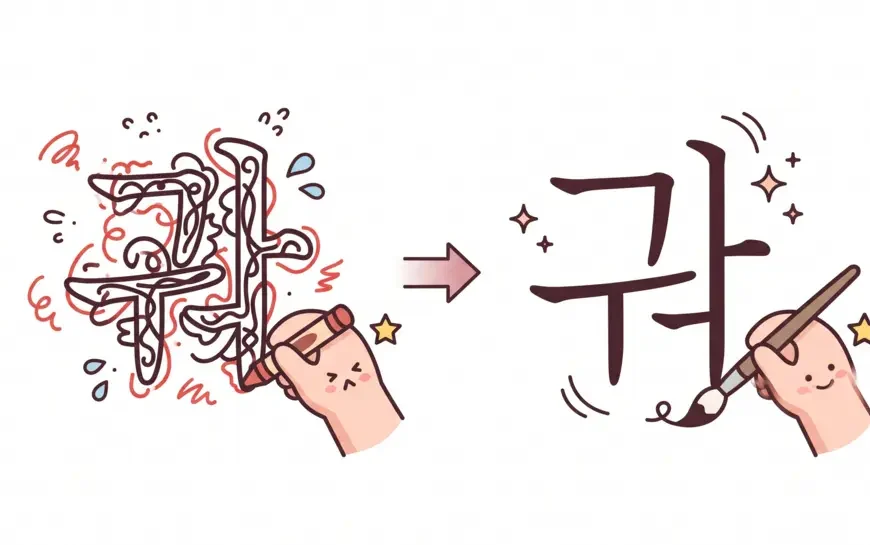
When you follow the correct stroke order, two great things happen: your handwriting becomes clean and proportional, and you naturally train your eyes to recognize native Korean handwriting, which often connects strokes fluidly.
Always remember these two golden rules:
- Top to Bottom (위에서 아래로): Vertical lines and top elements are always drawn downward.
- Left to Right (왼쪽에서 오른쪽으로): Horizontal lines and side strokes always move from left to right.
Never push your pen upward or backward from right to left. Maintaining this natural flow reduces hand fatigue and ensures your vowels align harmoniously with consonants later on.


Deep Dive: The 6 Core Basic Korean Vowels
Let’s explore the six core basic vowels featured in our printable worksheet. Mastering their distinct articulation and stroke sequence will make your daily Korean vowels writing practice far more effective.
1. The Vertical Pair: ㅏ [a] & ㅓ [eo]
- ㅏ [a]:
- Stroke Order: 1) Draw the long vertical line from top to bottom. 2) Add the short horizontal bar from left to right, attached to the right side of the vertical line.
- Pronunciation Tip: Open your mouth wide and relaxed, similar to the “ah” sound when a doctor asks you to open wide (as in father).
- ㅓ [eo]:
- Stroke Order: 1) Draw the short horizontal bar from left to right first. 2) Finish with the long vertical line going top to bottom.
- Pronunciation Tip: Many English speakers mistakenly pronounce this as “o”. Instead, drop your jaw slightly, keep your tongue back, and make a sound closer to the “u” in cup or “aw” in saw.
2. The Horizontal Pair: ㅗ [o] & ㅜ [u]
- ㅗ [o]:
- Stroke Order: 1) Draw the short vertical tick top to bottom. 2) Draw the long baseline horizontal bar from left to right underneath it.
- Pronunciation Tip: Shape your lips into a tight, rounded “O” shape and push them slightly forward. It is a pure, clean sound like in boat, without the trailing “w” sound.
- ㅜ [u]:
- Stroke Order: 1) Draw the long top horizontal line from left to right. 2) Draw the short vertical line downward from the center.
- Pronunciation Tip: Round your lips tightly, similar to the “oo” sound in moon or soup.
3. The Minimalist Pair: ㅡ [eu] & ㅣ [i]
- ㅡ [eu]:
- Stroke Order: A single smooth horizontal stroke from left to right.
- Pronunciation Tip: Pull the corners of your mouth wide into a flat, tensioned shape (almost as if you are grimacing slightly) and vocalize from your throat.
- ㅣ [i]:
- Stroke Order: A single crisp vertical stroke from top to bottom.
- Pronunciation Tip: Smile brightly and make a sharp, clean sound like the “ee” in tree or see.
3 Critical Mistakes to Avoid During Korean Vowels Writing Practice
Even enthusiastic learners can develop bad habits early on if they don’t know what to watch out for. As you work through your worksheets, be mindful of these three common traps:
- Relying Solely on English Romanization:Romanized spellings like eo and eu are merely approximations. If you rely too heavily on English letters, your tongue will default to English phonetics. Always associate the Korean letter directly with its visual shape and auditory sound.
- Reversing the Stroke Direction:Writing strokes from right to left or bottom to top may look identical on paper at first, but it ruins your writing rhythm and letter balance. Keep your strokes deliberate and disciplined.
- Forgetting the Placeholder Consonant ‘ㅇ’ (I-eung):In standard Korean orthography, a vowel cannot stand alone as a written syllable block. When a vowel forms a syllable without an initial consonant sound, the silent placeholder ㅇ must be placed in front of vertical vowels (e.g., 아, 어, 이) or on top of horizontal vowels (e.g., 오, 우, 으).
How to Use This Free Practice Worksheet for Maximum Results
To make the absolute most of your Korean vowels writing practice, we recommend following our proven 3-step mastery routine:
- Step 1: Trace the Guided Lines (따라 쓰기)Start by carefully tracing the light gray guide characters on the worksheet. Pay close attention to stroke length, spacing, and the designated numerical order.
- Step 2: Freehand Writing in the Grid (스스로 쓰기)Move to the blank boxes and write each vowel independently. Try to keep each character centered within the box so your hand learns standard proportions.
- Step 3: Say It Aloud While Writing (소리 내어 읽기)Never practice in silence! Every time your pen moves, vocalize the native sound clearly. Connecting visual motion, tactile feeling, and auditory feedback triples your retention speed.
Download Your Free Korean Vowels Practice Worksheet (PDF)
Ready to start writing? We’ve prepared a clean, printable, high-resolution PDF worksheet containing all six basic vowels, complete with clear stroke order diagrams, guided tracing boxes, and freehand practice grids.
- File Format: High-Quality Printable PDF (A4 / US Letter Friendly)
- What’s Included: 6 Core Vowels (ㅏ, ㅓ, ㅗ, ㅜ, ㅡ, ㅣ), numbered stroke order charts, stroke-by-stroke guides, and blank practice squares.
- Cost: 100% Free for all All About Korea 101 readers!
(Click the download button below to save the file directly to your device and print as many copies as you need for daily study!)
Conclusion
Mastering the basic vowels is your very first milestone toward unlocking the Korean language. By establishing solid handwriting habits today through consistent Korean vowels writing practice, you are building the foundation needed to conquer double vowels, consonant combinations, and full conversational sentences.
Take five to ten minutes each day to print out a fresh sheet, practice your strokes, and speak the sounds out loud.
Be sure to explore our other resources here on All About Korea 101, including our Slow Korean Podcast episodes, K-Drama dialogue breakdowns, and idiom guides. If you found this worksheet helpful, leave a comment below or share it with a fellow Korean learner. Happy studying, and see you in the next lesson!




![35 Useful Korean Phrases for Everyday Life [PDF]](https://allaboutkorea101.com/wp-content/uploads/2026/08/korean-phrases-870x545.webp)