If you’ve ever paused a K-drama to stare at a character’s phone screen, you’ve probably felt a bit lost. Texting in Korean looks almost nothing like the neat, full sentences you find in standard language textbooks. Instead, you see single Hangul consonants like ㅋㅋ, ㅇㅇ, or ㄱㄱ flying across the screen.
As a Korean language teacher with 10 years of classroom experience, my students constantly ask me: “Teacher, why are Koreans texting in code?”
The answer comes down to speed, efficiency, and emotional nuance. Understanding Korean texting slang is one of the fastest ways to bridge the gap between formal textbook Korean and real-life communication. Today, we are breaking down the top 10 chat abbreviations every K-drama fan should master.
Why Korean Texting Slang Is Essential for K-Drama Fans
Korea is world-famous for its ppal-li ppal-li (hurry, hurry) culture, and this mentality heavily influences how people send text messages. Typing out full honorific endings on a smartphone keyboard takes too long when you’re trying to send a quick reply to a friend. Korean speakers solved this problem by stripping words down to their initial Hangul consonants (known as 초성, choseong).
Over my decade of teaching, I’ve seen how learning Korean texting slang completely transforms a student’s reading speed and cultural understanding. When you recognize these abbreviations in K-dramas or on social media platforms like Instagram and Bubble, you aren’t just reading letters—you’re catching the exact emotional tone of native speakers in real time.
The 10 Most Common Korean Texting Slang Expressions
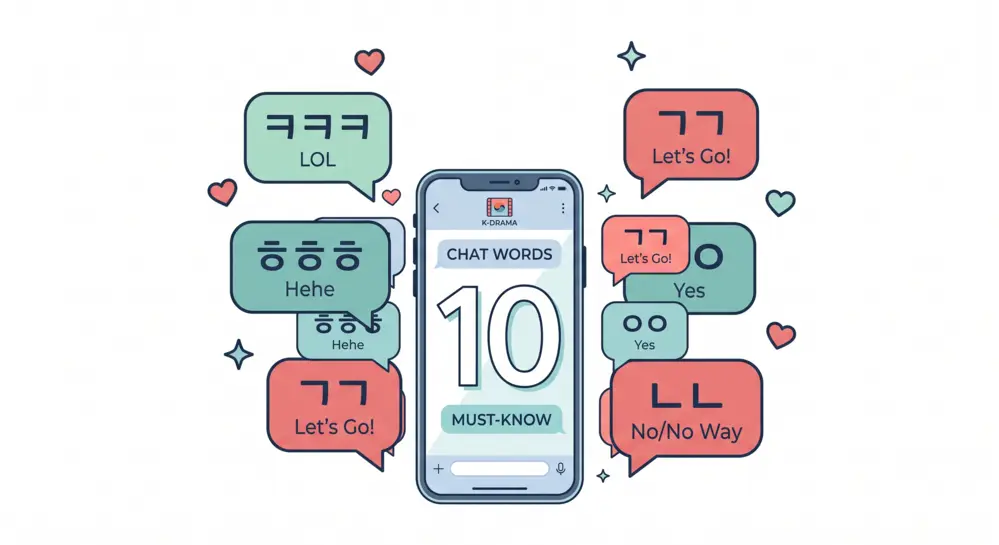
Here are the 10 most essential abbreviations you’ll spot in almost every K-drama texting scene.
1. ㅋㅋ (kk) – “LOL” or Laughing
This is the undisputed king of Korean texting slang. The consonant ㅋ represents the snickering sound ke-ke.
- Single
ㅋ: Slightly sarcastic, awkward, or dry chuckle. - Multiple
ㅋㅋㅋ: Genuine laughter or finding something legitimately funny.
2. ㅇㅇ (oo) – “Yeah” or “OK”
Short for eung (응), which is the casual way to say “yes” or “yeah.”
- Vibe: Super casual agreement between close friends.
3. ㄴㄴ (nn) – “Nope” or “No”
Short for no-no (노노).
- Vibe: A quick, friendly way to decline an offer or correct a mistake in chat.
4. ㄱㄱ (gg) – “Go Go!” or “Let’s do it!”
Short for go-go (고고).
- Vibe: Used when making plans or getting ready to start an activity (e.g., “Ready for lunch?” → “ㄱㄱ”).
5. ㄱㅅ (g-s) – “Thanks”
Short for gam-sa (감사), meaning “thanks.”
- Vibe: Extremely common in fast-paced group chats.
6. ㅊㅋ (ch-k) – “Congrats!”
Short for chu-ka (축하), which means “congratulations.”
- Vibe: Often doubled as
ㅊㅋㅊㅋto show extra enthusiasm for birthdays or achievements.
7. ㅠㅠ or ㅜㅜ (yu-yu / u-u) – Crying Emoji
While not consonant abbreviations, these Hangul vowels visually resemble eyes streaming with tears.
- Vibe: Used to show sadness, disappointment, or sympathy.
8. ㅇㅈ (ein-jeong) – “Agreed” or “Facts!”
Short for in-jeong (인정), meaning “acknowledged” or “I admit it.”
- Vibe: The ultimate agreement slang when someone states an undeniable truth.
9. ㄹㅇ (re-al) – “For Real” or “Legit”
Short for the English loanword real (리얼).
- Vibe: Used as a question (“ㄹㅇ?” = For real?) or a statement (“ㄹㅇ!” = Seriously!).
10. ㅁㄹ (m-r) – “IDK” (I Don’t Know)
Short for mol-ra (몰라), which means “I don’t know.”
- Vibe: A short, direct response when you don’t have an answer.
Korean Texting Slang Cheat Sheet
To help you review quickly before your next drama binge, here is a simple reference table comparing full Korean words, texting abbreviations, and English equivalents:
| Texting Slang | Full Word | English Equivalent | Tone Level |
| ㅋㅋ | 크크 (Ke-ke) | LOL / Haha | Casual |
| ㅇㅇ | 응 (Eung) | Yeah / OK | Very Casual |
| ㄴㄴ | 노노 (No-no) | Nope / No | Casual |
| ㄱㄱ | 고고 (Go-go) | Let’s go! | Energetic |
| ㄱㅅ | 감사 (Gam-sa) | Thanks | Casual |
| ㅊㅋ | 축하 (Chu-ka) | Congrats | Warm |
| ㅇㅈ | 인정 (In-jeong) | Facts / Agreed | Trendy |
| ㄹㅇ | 리얼 (Ri-eor) | For real? / Legit | Casual |
Teacher’s Warning: Rules for Using Korean Texting Slang Safely
As a 10-year veteran instructor, I always give my students one critical piece of advice: Korean texting slang is strictly reserved for casual, equal-status relationships.
Korean culture places a high value on social hierarchy, age, and politeness. Texting ㅇㅇ or ㄱㅅ to your boss, professor, or older in-laws will instantly make you look rude or disrespectful, even if your intentions are pure.
Golden Rule: Stick to standard, polite Korean (jondaetmal) with elders and workplace superiors. Save these Korean texting slang shortcuts for close friends, peers, and fellow K-drama lovers!