Hey guys, welcome back!
Every single semester, I have a student who comes to me after a heavy K-drama binge, completely emotionally exhausted. They always ask the same thing: “Teacher, how do I actually translate what they are feeling right now?”
Usually, they are twisting their brains over two massive, beautifully complex emotional concepts that standard dictionary apps completely fail to explain: Jeong (정) and Han (한). These aren’t just vocabulary words—they are the dual heartbeats of how Koreans feel, connect, and heal.
If you want to stop sounding like a stiff translation app and finally start communicating from the heart, let’s break down these “untranslatable” emotions using real-life vibes you can actually use.
1. The Invisible Glue: “Jeong” (정)
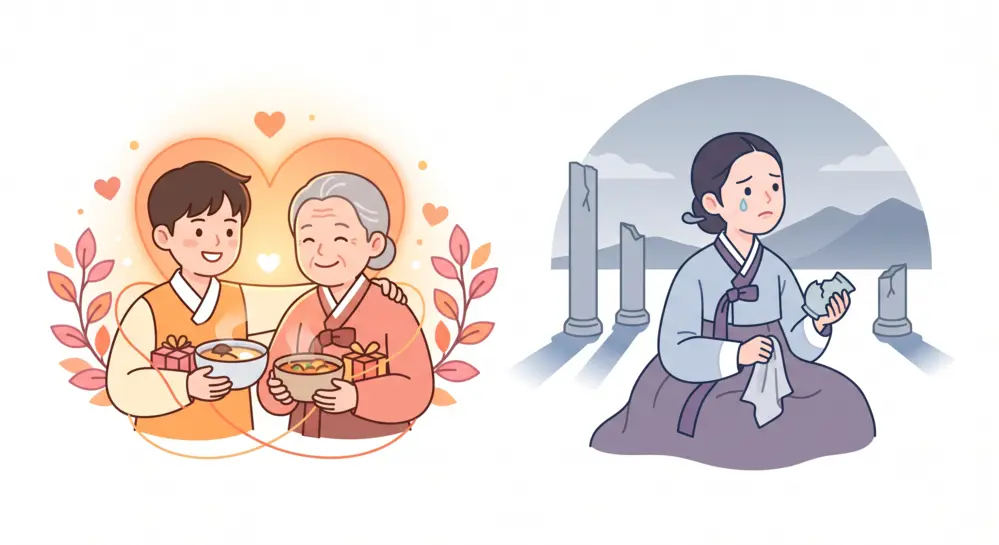
If you look up Jeong in a dictionary, it spits out words like “affection” or “attachment.” But those don’t quite hit the mark. In Western culture, affection is usually an individual feeling you actively have for someone. Jeong, however, is a sticky collective bond that grows between people over time. It’s the reason why Koreans show love through subtle actions rather than loud verbal declarations.
To bring this into your daily conversations, here are the real words you need to know:
- 정이 들다 (Jeong-i deulda): This describes the natural birth of Jeong. It implies that time has passed, and you’ve grown fondly attached to a person, a place, or even an old item.
- Real-life phrasing: “우리 그동안 정이 많이 들었네요.” (We’ve really grown close over time, haven’t we?)
- 따뜻하다 (Ttatteuthada): While it literally means physically warm, using it for someone’s character means they have a deep, genuine capacity for Jeong.
- Real-life phrasing: “그 사람은 마음이 참 따뜻해요.” (They have such a warm heart.)
- 뭉클하다 (Mungklhada): That sudden, warm swelling in your chest when you witness pure, unexpected kindness—like a restaurant owner piling extra food on your plate for free.
- Real-life phrasing: “가슴이 뭉클했어요.” (It really touched my heart.)
2. The Quiet, Heavy Ache: “Han” (한)
If Jeong is the warm light of Korean emotion, Han is its deep, melancholic shadow. It’s often translated as “resentment” or “grief,” but to my students, I describe it as a deep-seated ache born from enduring hardship, unfulfilled desires, or long-standing injustice—yet carrying it forward with quiet resilience.
Think of those intense scenes where a character swallows a massive lump of pain and just keeps moving forward. That heavy feeling is Han.
- 한이 맺히다 (Han-i maethida): When a deep sorrow or an unfulfilled lifelong dream hardens into a permanent emotional knot.
- Real-life phrasing: “그 일은 나에게 평생의 한이 되었어.” (That became a lifelong sorrow in my heart.)
- 답답하다 (Dapdaphada): One of the most useful words in Korean. When the weight of a situation or Han becomes too heavy, it physically feels like you can’t breathe.
- Real-life phrasing: “가슴이 너무 답답해요.” (My chest feels so tight and suffocated.)
- 서글프다 (Seogeulpuda): A step beyond just being sad (seulpuda). It carries a specific tinge of helpless, lonely melancholy.
- Real-life phrasing: “기분이 참 서글프네요.” (I feel a deeply lonely kind of sad.)
3. The Coping Mechanism: Turning Pain Into Connection
What makes Korean emotional dynamics so beautiful is that Han and Jeong constantly interact with each other. In Korean culture, you don’t just suffer through your heavy sorrows (Han) alone. You share that pain with others, and through that shared vulnerability, an incredibly deep bond of mutual understanding (Jeong) is born.
When you are practicing these words, remember that native speakers value emotional authenticity over perfect textbook grammar. In my classes, I never, ever call out my students for making mistakes. My absolute priority is keeping the conversation flowing naturally, not obsessing over every single grammar rule. And honestly, when students stop worrying about being perfect and just focus on connecting, a complete miracle happens every single time—the conversation magically keeps going, and they find themselves communicating effortlessly.
Quick Reference: The Survival Guide for Korean Enotions
To help you navigate these heavy concepts next time you are chatting with a friend or reacting to a deep drama scene, use this quick cheat sheet:
| The Emotion | Core Vibe | Key Vocabulary | When to Use It |
| Jeong (정) | Warmth, sticky connection, bonding | 정이 들다, 마음이 따뜻하다, 뭉클하다 | When thanking a close friend, or feeling touched by someone’s kindness. |
| Han (한) | Unresolved ache, deep sorrow, heavy heart | 한이 맺히다, 가슴이 답답하다, 서글프다 | When talking about a deep, bittersweet life experience or reacting to a tragic plot twist. |
Essential Korean Wrap-Up: A Heart-to-Heart Advice from Your Korean Teacher
Whenever I explain the concept of Jeong to my own students, I always point to our own relationship. I look at them and say, “Think about it—we’ve been meeting up every single week for class, and looking back at all that time we’ve spent together, we’ve really developed a deep sense of Jeong.” The moment I say that, the lightbulb goes on. They instantly get it.
Learning these deep emotion words isn’t about memorizing a textbook page. It’s about catching the vibe and trying to speak exactly like real people do.
In my classes, I never, ever call out my students for making mistakes. I care way more about keeping the conversation flowing than obsessing over perfect grammar rules. And honestly? When my students stop stressing about being perfect, a total miracle happens every time—the conversation magically keeps going, and they find themselves communicating effortlessly.
So, don’t be afraid to put your heart out there. Try throwing a warm phrase into your next conversation. Keep practicing, and remember—I’m always right here cheering you on!
What’s a K-drama scene that made you feel the heavy ache of Han or the pure warmth of Jeong? Drop a comment below and let’s chat!