If you are a fan of K-dramas, you’ve probably noticed that characters have a very specific, highly expressive way of showing anger. From the dramatic deep sigh to the classic “grabbing the back of the neck” (known as dwit-mok jap-gi / 뒷목 잡기 in Korean), expressing anger in Korean is practically an art form. As a Korean language instructor with over 10 years of experience helping thousands of foreign learners, one of the most common requests I get is: “Teacher, what are they actually saying when they get mad? My textbook only teaches me polite words!” Today, we are going to step away from the boring, stiff textbook dialogues and dive deep into the real, everyday angry korean phrases that will make your K-drama viewing experience ten times more relatable (and help you understand native speakers on a whole new level).
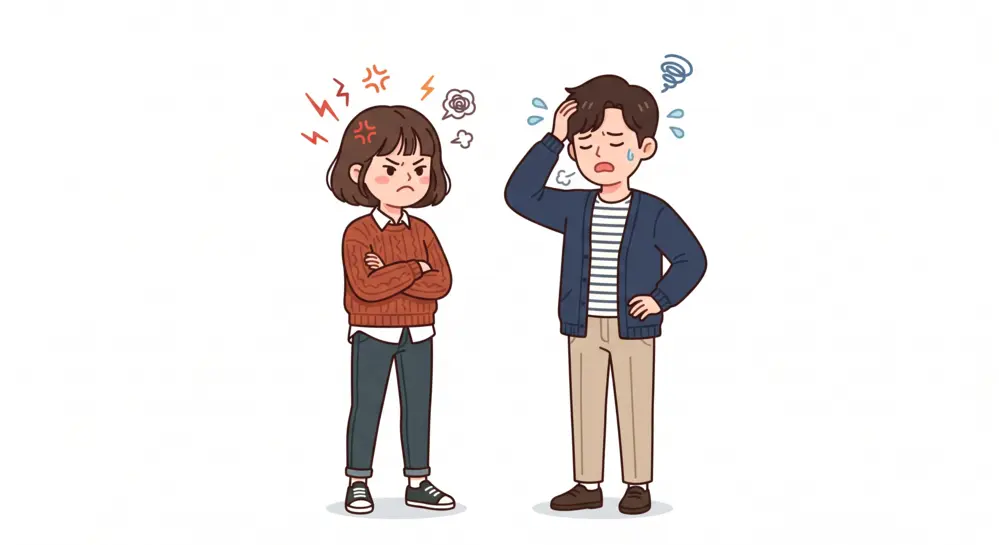
Why K-Dramas A Packed with Angry Korean Phrases
Before we look at the list, we need to understand a quick cultural point. Korean is a deeply contextual and emotional language. When people get frustrated in Korea, the language shifts dramatically. The tone drops, the speed increases, and polite grammatical endings (-yo or -seumnida) often fly right out the window. In my 10 years of teaching, I’ve noticed that students who learn these angry korean phrases actually understand the emotional subtext of K-dramas much faster than those who only study standard grammar. Let’s look at the 7 most common expressions for frustration you’ll hear on screen.
1. 아, 진짜! (Ah, jin-jja!) – “Ah, seriously!”
- If you’ve watched even one episode of a K-drama, you have heard this. It is the ultimate gateway to expressing annoyance.
- How to pronounce it: Ah, jin-jja!
- What it literally means: “Ah, really!” or “Ah, truly!”
- When to use it: When something minor but annoying happens. For example, your character drops their phone, misses the bus, or is dealt a mildly frustrating hand by a clumsy male lead.
- Teacher’s Insight: Native speakers rarely say just “Jin-jja?” (Really?) when they are mad. It’s that sharp, exasperated “Ah” at the beginning that carries 90% of the frustration.
2. 답답해! (Dap-dap-hae!) – “It’s so suffocating!” / “I’m so frustrated!”
This is a beautiful Korean word that doesn’t have a direct, single-word translation in English. It refers to both a physical and psychological feeling of tightness.
- How to pronounce it: Dap-dap-hae!
- What it literally means: “It is congested/stifling.”
- When to use it: When someone is being incredibly dense, won’t speak their mind, or when a situation is stuck and going nowhere.
- Teacher’s Insight: In Korea, we associate extreme frustration with the chest area. When a character beats their chest with their fist in a drama, this is the exact word they are thinking of.
3. 어이가 없네 (Eo-i-ga eop-ne) – “This is utterly absurd.”
This phrase gained massive pop-culture status in Korea thanks to veteran actor Yoo Ah-in’s iconic villain monologue in the movie Veteran.
- How to pronounce it: Eo-i-ga eop-ne
- What it literally means: “The handle of the millstone is missing.” It means you have the tools to do something, but the vital part is missing, making the situation ridiculously absurd.
- When to use it: When someone does something so shockingly rude or illogical that you are left completely speechless.
4. 미치겠네 (Mi-chi-get-ne) – “I’m going crazy.”
This is the go-to line for characters who are pushed to their absolute limits. You will often see them running their hands through their hair while saying this.
- How to pronounce it: Mi-chi-get-ne
- What it literally means: “I think I’m going to go mad/insane.”
- When to use it: When stress levels are peaking, problems are piling up, and you literally do not know what to do next.
5. 됐어 (Dwaes-seo) – “Forget it.” / “I’m done.”
This is a passive-aggressive powerhouse of a word. It is short, sharp, and highly effective at shutting down conversations.
- How to pronounce it: Dwaes-seo!
- What it literally means: “It is done” or “It is sufficient.”
- When to use it: When you are arguing with someone, and you realize talking to them is a waste of breath.
- Teacher’s Insight: If a character says “Dwaes-seo” in a quiet, flat tone, it is actually much scarier than if they scream it. It means they are emotionally checking out of the conversation.
6. 돌겠네 (Dol-get-ne) – “My head is spinning.” / “I’m losing my mind.”
Similar to mi-chi-get-ne, but with a slightly different flavor.
- How to pronounce it: Dol-get-ne (발음: 돌겠네)
- What it literally means: “I am going to spin/rotate.”
- When to use it: When a situation is so chaotic and confusing that your brain feels like it is literally spinning inside your head.
7. 열받아 (Yeol-bad-ah) – “I’m so pissed off!”
If you want a phrase that directly matches the English slang “I’m heated,” this is the one.
- How to pronounce it: Yeol-bad-ah
- What it literally means: “To receive heat.”
- When to use it: When your anger is tangible, active, and making your blood boil.
- Teacher’s Insight: You can turn this into a question to ask someone if they are mad: “Yeol-bad-ah?” (Are you pissed?) or say “Yeol-bad-ge ha-ji-ma” (Don’t make me mad).
A Teacher’s Warning: The Politeness Trap
Here is where my 10 years of classroom experience comes in. Please pay close attention to this! Almost all the angry korean phrases listed above are in Banmal (반말), which is informal, casual Korean.
| Relationship Type | Appropriate Speech Level | Example Adjustment |
| Close friends, younger people / 친구, 아랫사람 | Banmal (Informal / 반말) | 아, 진짜! (Ah, jin-jja!) |
| Bosses, elders, strangers / 상사, 어른, 낯선 사람 | Jon-daet-mal (Polite / 존댓말) | 아, 진짜요! (Ah, jin-jja-yo!) |
| Strictly professional settings / 매우 격식 있는 자리 | Sigh & stay silent / 한숨 쉬며 침묵 | (Avoid verbal anger / 직접적 분노 표현 자제) |
Crucial Rule / 가장 중요한 규칙: If you use Banmal anger expressions with your boss, your Korean in-laws, or a stranger on the street, you won’t just sound frustrated—you will sound incredibly rude. If you must express frustration politely, always add -yo (요) to the end of phrases like 진짜 (jin-jja -> jin-jja-yo) or 답답해 (dap-dap-hae -> dap-dap-hae-yo).
Wrap Up: Listen For Them In Your Next Drama!
Now that you know these 7 core angry korean phrases, your homework for tonight is to open up Netflix, put on your favorite K-drama, and see how many of these you can spot within the first 15 minutes. You’ll be surprised by how often they pop up!
Learning a language isn’t just about passing tests; it’s about connecting with real human emotions. By understanding how Koreans express frustration, you are taking a massive step toward true fluency. What is your favorite Korean expression of frustration from K-dramas? Let me know in the comments below!